It goes without saying that staying hydrated during exercise is absolutely essential. But the question arises: what’s the most convenient way to take water with you on your run? The most obvious choice is a classic water bottle. Simple, cheap, and it works. But is it the best solution? Not necessarily. The world of running accessories offers a few smarter options. These have their pros (and cons), and the choice depends mainly on distance, intensity, and personal preference.
The “Bush Bottle” Trick – Not Exactly Genius
This solution is theoretically the simplest and requires nothing more than a water bottle. We leave it in a familiar spot and then plan our route so that we pass by it every so often – for example, every 40 minutes – and can take a drink.
Advantages of this solution:
- first and foremost, simplicity – all you need is a water bottle,
- you don’t have to carry liquids with you, so you can leave a larger supply of water behind, such as a large bottle,
- the lack of extra weight while running positively affects comfort and freedom of movement.
The downsides, however, are greater:
- first and foremost, you’re forced to run in the same spot the whole time. If you drink every 30–40 minutes, you have to keep returning to the same bottle, which severely limits your ability to explore new routes,
- and you also lose full control over how often you drink. If the temperature turns out to be higher than you expected and you need to hydrate more frequently – for example, every 30 minutes – you’ll have to shorten your loop. Otherwise, you won’t drink when you actually need to,
- there’s also a risk that someone will take, hide, or spill your water. You can never be sure what happens to your drink when you leave it unattended.
Personally, I think this is an impractical solution. In practice, it works best when running on a track or on short, repetitive loops.
Handheld Bottle – Fine for Short Runs
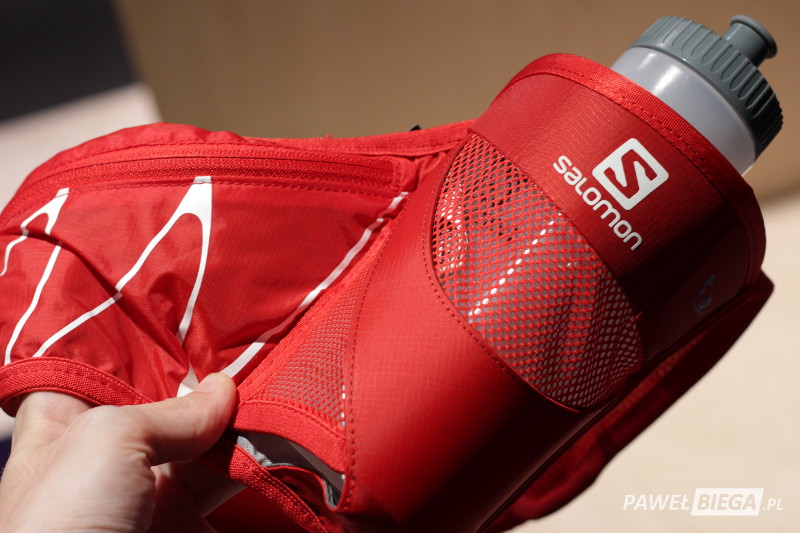
So you can simply take a water bottle with you. This solution has several clear advantages:
- first of all, you don’t have to limit yourself to a single route or keep returning to where you left the bottle,
- you have full control over how often and how much you drink. If it gets warmer, you can immediately increase how often you hydrate. When the temperature is lower, you just need to drink less often,
- and no one will take your bottle or accidentally knock it over, because you have it with you the whole time.
In practice, this means that most of the drawbacks of the previous solution become advantages here. This doesn’t mean, however, that carrying a bottle is perfect. This method has one major drawback.
Throughout the entire run, you have to hold the water in your hand – either your right or left. Over time, this starts to get tiring. The bottle itself weighs something, and on top of that, one hand works differently than the other. After a kilometer, you usually don’t feel it. After five kilometers, it starts to get in the way. After ten or fifteen, you just want to throw the bottle away.
In summary, running with a bottle in your hand works best only occasionally and mainly for shorter distances – up to about 10 kilometers at most. For longer runs, it’s worth looking for a solution that allows you to carry water without using your hands.
Hydration at Your Hips – Smart and Simple
The advantages of this solution are very similar to running with a bottle in your hand. After all, a water bottle attached to a belt is, in a sense, simply a more convenient way to carry a bottle. This means that:
- you can run wherever you want and however you want, while keeping water with you at all times,
- you have full control over how much and how often you drink,
- your hands remain free, so nothing weighs down your hands or interferes with your arm movement while running.
This solution has virtually no downsides for everyday running. However, to take full advantage of its benefits, it is crucial to adjust the belt to fit your body. If the belt is too loose and starts bouncing excessively while running, comfort will quickly decline. If it is too tight, it may even restrict your movements. That is why it is worth choosing models with an elastic waistband and – if possible – trying them on before purchasing to check if they fit your body well.
A well-fitting belt works well in practice

Hydration Vest – Built for the Long Run
A backpack or vest with a hydration bladder is the most advanced solution. It involves using a special running backpack with a built-in water bladder. The bladder has a much larger capacity than a standard water bottle. Options are available in 1-liter, 1.5-liter, and 2-liter sizes.
Advantages of this solution:
- you can carry a large supply of water, so you shouldn’t run out even on very long runs,
- you can fit much more in a backpack than in a waist belt. In addition to your phone, you can store a jacket, a map, or a larger amount of food – not just gels. Better models also have front pockets on the shoulder straps. You can keep energy gels in them, allowing you to grab them without stopping your run or taking off the backpack,
- extensive adjustability lets you tailor the vest to your body shape, clothing, and current load. A fully loaded backpack sometimes requires a slight adjustment to ensure it sits stably and comfortably.
In practice, this is a very comprehensive solution that’s hard to beat in terms of functionality. The biggest drawback might be the price. Good, lightweight, and well-fitting running vests often cost as much as a solid pair of running shoes – several hundred zlotys. On the other hand, this is gear that will last for many seasons, so it might pay off in the long run.
A backpack works best for long and very long distances, usually over 25–30 kilometers. On shorter runs, its capabilities simply go unused. Still, it remains the most comfortable and practical solution, though also the most expensive.