I run in shoes ranging from size 45.5 to 47.5. And no, I don’t just buy random sizes. They all fit me well. Sounds absurd? Only at first glance. This perfectly illustrates just how far European sizing for running shoes can be from reality.
I’ve already written many articles about running shoe sizes. Despite that, there are still people who think that 2 mm of wiggle room in front of the toes is definitely too much. Well… these are not my toes and these are not my toenails. I’ve been choosing shoes with extra room for a long time. How much extra? It depends.
I’ve explained to customers many times that you can’t simply say: if you wear a 44 every day, you should buy a 45 for running. Similarly, just because you run in a size 46 in Nike doesn’t mean a 46 will fit in Adidas either. Maybe it will. Or maybe not. That’s why I often use my own example. On a daily basis, I usually wear a 45, sometimes a 46. However, my running shoes range in size from 45.5 to 47.5. This best illustrates just how wide the range can be.
Running Shoe Size
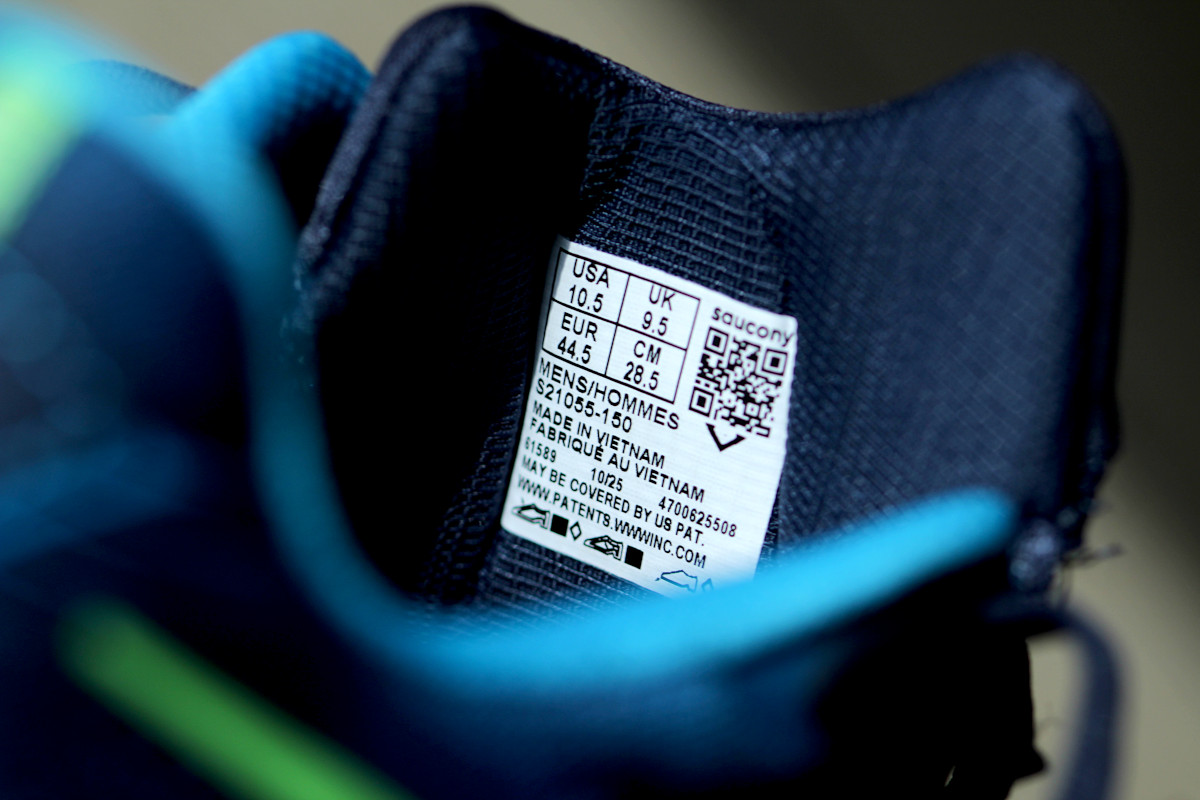
The most commonly accepted rule is to add about 1 cm to the length of your foot measured while standing and use that as the basis for choosing the insole length. My feet are 29.2 and 29.7 cm long. According to this rule, I should therefore choose shoes with an insole length of 30 or 30.5 cm. Which ones exactly? From experience, I know that I usually end up with 30 cm. About three-quarters of these running shoes have insoles of exactly that length, but I often can’t make a decision without trying them on anyway.
Out of curiosity, I went through all these running shoes and checked the length of their insoles. Here are the results:
| INSOLE LENGHT (cm) | RUNNING SHOES | PERCENT |
|---|---|---|
| 29,5 | 12 | 11% |
| 30 | 84 | 74% |
| 30,5 | 17 | 15% |
| 31 | 1 | 1% |
As you can see, the vast majority of my shoes have a 30 cm insole. Still, I also have models in my closet with insoles measuring 29.5 cm, 30.5 cm, and even one with a 31 cm insole.
The situation is similar with US sizing. Here, too, these sizes dominate, but they’re not the only sizes I run in.
| US SIZE | RUNNING SHOES | PERCENT |
|---|---|---|
| 11,5 | 11 | 10% |
| 12 | 72 | 63% |
| 12,5 | 30 | 26% |
| 13 | 1 | 1% |
What Are European Sizes Good For?
All right. Since insole length and US sizes are fairly consistent, let’s get back to the question that comes up most often: What size should you choose if you usually wear a 44? There’s no way to answer that question.
European sizing is so inconsistent that the same insole length can correspond to different sizes depending on the producer. For example, a 30-centimeter insole in Nike corresponds to size 46, but in adidas it’s 46 2/3. So I decided to check how this plays out in practice with all my shoes. The result? Although the vast majority have a 30-centimeter insole and a US size 12, if I look solely at the EU sizing, I run in shoes ranging from 45.5 to 47.5.
| EU SIZE | RUNNING SHOES | PERCENT |
|---|---|---|
| 45,5 | 4 | 4% |
| 45 2/3 | 1 | 1% |
| 46 | 36 | 32% |
| 46,5 | 19 | 17% |
| 46 2/3 | 24 | 21% |
| 47 | 21 | 18% |
| 47 1/3 | 7 | 6% |
| 47,5 | 2 | 2% |
That’s why I think the European sizing system for running shoes is useless. We’re used to it, but in practice, it doesn’t tell us much. These are the insole length in centimeters or the American sizing system. Although even these aren’t foolproof.
Paweł, Why?
The number on the box alone doesn’t tell the whole story. These models have wide forefoots, but they taper sharply toward the toes. One has a softer upper, while the other has a stiffer construction. There are shoes where I immediately feel like I can go a size smaller, and others where I prefer to leave a little more room. This way, I maintain a similar level of comfort even though the size on the box is different.
The intended use of the shoe also matters. If I know a particular model will be used mainly for shorter workouts, I can leave a little less wiggle room. If it’s meant to be a marathon shoe, I prefer to have a bit more. If I were preparing for an ultra run, I’d probably choose an even larger size.
The same applies to trail shoes. On downhills, your foot slides forward, and a stiff toe box can easily put pressure on your toenails. That’s why there isn’t a one-size-fits-all solution here either. You have to approach this on a case-by-case basis.
Running Shoe Size
That’s why I’m usually able to determine my size fairly precisely using the insole length (30 cm) or the US size (12 US). However, if someone asks me about the European size, the answer is: “It depends.”
Because I’ve run – and still run – in shoes ranging from 45.5 to 47.5. And all of them fit well. If you want to make the right choice, too: measure your foot, check the insole length, and try the shoe on. Because the EU size alone often means much less than we think.