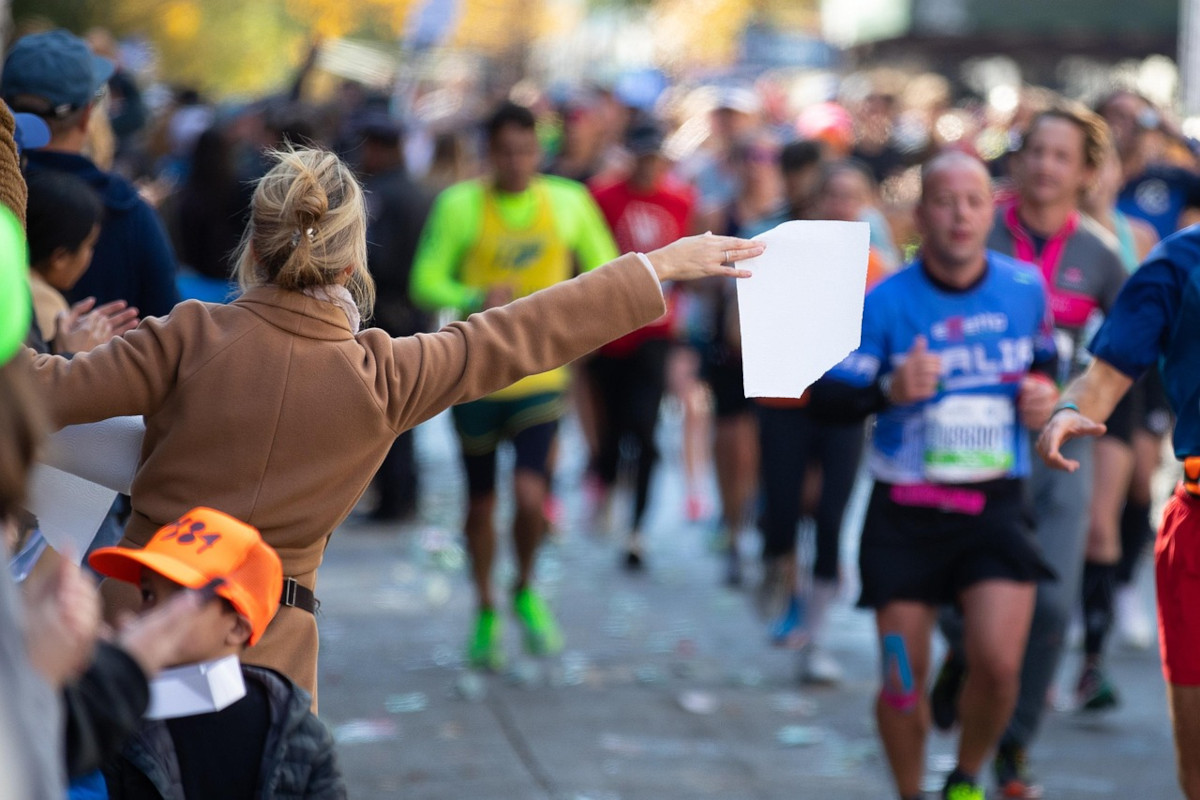
A marathon isn’t just about physical fitness. It’s the sum of your decisions. You can be 100% prepared. Your plan is set. Your training is done. And then you still mess it up. With a single decision. With a single “oh, I’ll give it a try.” I’ve done that too. I’ve also ruined my own marathon by my own choice. Here are five situations from the course. These cost me time or energy. These are lessons that would have been better to learn during training, not during a crucial race.
An experiment on the course: a new gel
A classic: last-minute experimentation. It wasn’t until the day before the race that I realized I was short on gels. That was many years ago. Back then, I was running on trusted Nutrenda, and everything worked as it should – no surprises, full control.
At the Expo, I made a quick tour of the booths. And bam. Nutrenda was nowhere to be found. I bought Vitargo, which I knew but had never used before. My reasoning was simple: “it’s just a gel.”
On the course, it turns out it wasn’t “just” that. It didn’t end in a spectacular disaster, but it didn’t feel right from the start. Bloating, a strange aftertaste, discomfort as if I’d eaten something stale. I was running my own race, but my stomach kept reminding me that this wasn’t what it was used to from training.
It wasn’t a Vitargo issue. It was my mistake. Your body isn’t a testing ground on race day.
The conclusion is simple: nothing new on marathon day. All I needed to do was stock up on a supply of a tried-and-true gel a few days earlier.
Too much food before the marathon – all the portable toilets were mine
I’ve never been on a diet. I’ve never bothered with counting macros. I always eat normally. Before the race, I almost always ate without any fancy combinations – just a usual breakfast that I know and that works.
That one time, many years ago, I decided to “do it right,” meaning to do a carb load. The general rule: first three days without carbs, then three days of high-intensity training and lots of carbs. Those six days were great. The days without carbs weren’t a problem. The days when I ate more pasta and other carbs were a pleasure. I ate my last carbs – in smaller amounts, of course – before the marathon start.
The plan was ambitious back then. The result… spectacular…
Everything was going perfectly until the 15-kilometer mark. Then my stomach started churning. More and more with every kilometer. At the 15-kilometer mark, I was scanning for the first portable toilet. Relief for a moment. Three kilometers further on, the same thing again…
Another restroom. And then again. Between 15 and 25 km, I practically hit every restroom station there was. My legs still had strength. My heart rate was on point. But what good was that, when the run had turned into a series of interrupted intervals?
As a result, for the last dozen or so kilometers, I was even afraid to drink at the aid stations so I wouldn’t have to use the restrooms again. It worked. I ran the finish normally, without any problems. Except that what I’d lost earlier stayed on the course.
And again – it’s not that carb loading doesn’t work. The problem was elsewhere – I was doing it for the first time right then. I’d never tested it before. I didn’t know how my body would react. Maybe it needs slightly fewer carbs? Or in different proportions?
Conclusion? Same as with gels – no experiments.
Finishing too early – a wall is guaranteed
That was a mistake that actually cost me my personal best. It happened in Warsaw. At the time, my personal best was 3:28, and I had a solid plan: run comfortably at a 3:30 pace and shave some time off in the final kilometers. I lined up with the pacemakers, and everything went perfectly from the start. Steady pace, control, no jerking. 5, 10, 15, 20, 25, 30 km – textbook.
And then suddenly, the 35th kilometer. The border between Ursynów and Mokotów. Still a long way to the finish line in the city center. A refreshment station, a bit of chaos, and the group that had been running in a tight pack just moments before broke apart. Now I’m out in front. I felt great, so without much thought, I kept running. Alone. Instinctively, I picked up the pace slightly and began passing other runners. A simple thought in my head: “I have reserves; I need to use them.”
I had reserves. For a moment.
Around 39–40 km, I start to fall behind. My pace drops. My legs are still trying, but my body says “stop.” On my own, without the group, I can’t keep this up. My lead vanishes, and after a moment I see the familiar balloons.
The pacemakers are catching up to me.
At the finish line: 3:30 net. Plan accomplished… but my personal best remained untouched. Conclusion? Patience wins in a marathon. Not some fanciful notion. All I had to do was stick with the group and the plan at least until the 40th kilometer.
I kept running even though I should have dropped out
It wasn’t a mistake anymore. It was just usual stupidity.
I went to the Wrocław marathon on antibiotics. On top of that, it was sweltering that day. From the start, I felt that my body wasn’t functioning as it should. I was feeling weak, so I started very cautiously. Slower, calmer, without any pressure.
Except that didn’t help at all.
It got worse with every kilometer. After every five kilometers, I consciously let up more and more. By around 20 km, I was already jogging and dragging my feet. The run turned into a struggle for every single kilometer. I counted them down, walked, drank water, ate, and at the same time felt weaker and weaker.
After the 30th kilometer, my body said “enough.” I felt so weak that at one point I sat down on the sidewalk and then lay down in the shade of a tree. Spectators handed me water. They asked if they could help. How could they help? Strangers definitely had a better grasp of the situation than I did.
That was the moment when I should have left the course and waited for the paramedics to take me away. Maybe I should have gotten electrolytes then? Sugar? I have no idea. I definitely should have stopped continuing the race. That’s what was missing then – letting go. The thought in my head was: “I’m not leaving the course.” Except my body had a completely different opinion.
I walked the rest of the course and sat down on the sidewalks a few more times. I tried to remember the names of the medications I take in case I had to give that information to someone… I finished the race… but I don’t recommend it…
To this day, I consider continuing that “run” to be foolish.
The conclusion? Health is non-negotiable. Sometimes the greatest strength is to drop out before your body does it for you.
Starting after work – a terrible idea
I went to Gdańsk exhausted. Not “a little,” but after seven days of work in a row. After seven nights where I didn’t always get the sleep my body needed because I was training in the evening or first thing in the morning. My mind wanted to run, but my body had already run its own marathon.
The trip to Gdańsk also played a role – 3 hours on the train straight from work.
How could this have ended? Only these ways.
Up to the 20-kilometer mark, things were still somewhat okay. I was keeping pace, everything looked normal. But it was an illusion. I hit the “marathon wall” after just 20 kilometers. My legs felt empty, I had no power, and my pace dropped dramatically.
Of course, for a while I still tried to fight to finish with a decent result, but… in the end, all I could do was watch as these runners passed me one after another.
The finish? No strength. No satisfaction.
The conclusion is simple: you have to arrive at a marathon well-rested, not just well-trained.