These days, the term “fast running shoes” appears frequently in descriptions of new models. Manufacturers boast about dynamic performance, energy return, responsiveness, and carbon plates designed to help maintain a high pace. In practice, however, none of these technologies are what make a running shoe feel fast. Read on to find out what really makes a running shoe feel faster.
What Does It Mean When a Running Shoe Feels Fast?
A fast running shoe is a model that makes maintaining a high pace easier. It’s not just about being lightweight. The key is how the shoe interacts with the foot during a fast stride. A well-designed midsole helps you transition more quickly from landing to pushing off. This makes your run smoother and more efficient.
In practice, a shoe’s “speed” depends on many factors. Modern models use highly responsive foams. These materials compress under load and release some of that energy during the push-off. This creates a slight “bounce” that helps you maintain a fast pace with less effort. Midsole geometry is also important. Many fast models have a pronounced rocker, which is a rounded profile at the front of the shoe. This allows the foot to roll forward more quickly. Often, there is also a carbon fiber plate or nylon insert that stiffens the construction and acts as an additional “trampoline.” Together, all these elements make the shoe conducive to faster running.
Of course, a running shoe is just one piece of the running puzzle. With “slow” running shoes, you can build up to near-sprinting speeds. In dynamic “fast” shoes, you can jog by dragging one foot after the other. In the long run, however, it’s more comfortable to run slowly in “slow” shoes and fast in “fast” ones.
What Makes a Running Shoe Dynamic?
The dynamics of a running shoe aren’t determined by a single construction element. Rather, it results from a combination of features in the midsole and the shoe’s overall geometry. The most important factors are the foam’s rebound, the stiffness of the midsole, and how the foot rolls during a run.
Lightweight Design
The first and simplest way to improve a shoe’s dynamic performance is to lighten it. After all, shoes have weight, and we carry that weight with every running step. Lightening a shoe by 50 grams might not seem like much at first, but multiply that by 35,000 steps in a marathon, and it adds up to a significant amount. The lighter our shoes are, the easier it is on our feet. It’s that simple.
Lightening the shoe currently takes various forms. Uppers are made lighter by using ultra-thin, ultra-lightweight mesh. The midsole can be thinner and offer less cushioning or be made of lighter foam. Shoes may also have less rubber in the outsole. There are many places where shoes can be made lighter, and every gram saved means the shoe weighs less. In theory, this allows you to run faster.
However, shoes cannot be made lighter indefinitely. Otherwise, we’d eventually conclude that running barefoot or in socks is the fastest way, but that’s not necessarily true, nor is it necessarily the most comfortable. While a lighter weight makes the shoe “faster,” it should also incorporate features that make it more dynamic.

Responsive Foams and Carbon Plates
The second important factor is the foams used to make “fast” shoes. These materials are often lightweight and more responsive, or springier, than those used in “slower” shoes. This means that, upon push-off, they return some of the energy expended during landing. These differences are minor, but the same principle applies as with lower weight. They may not be noticeable during a few-kilometer run, but over a marathon distance and after 35,000 steps, the shoe’s ability to save a fraction of the energy expended in each foot movement will make a difference.
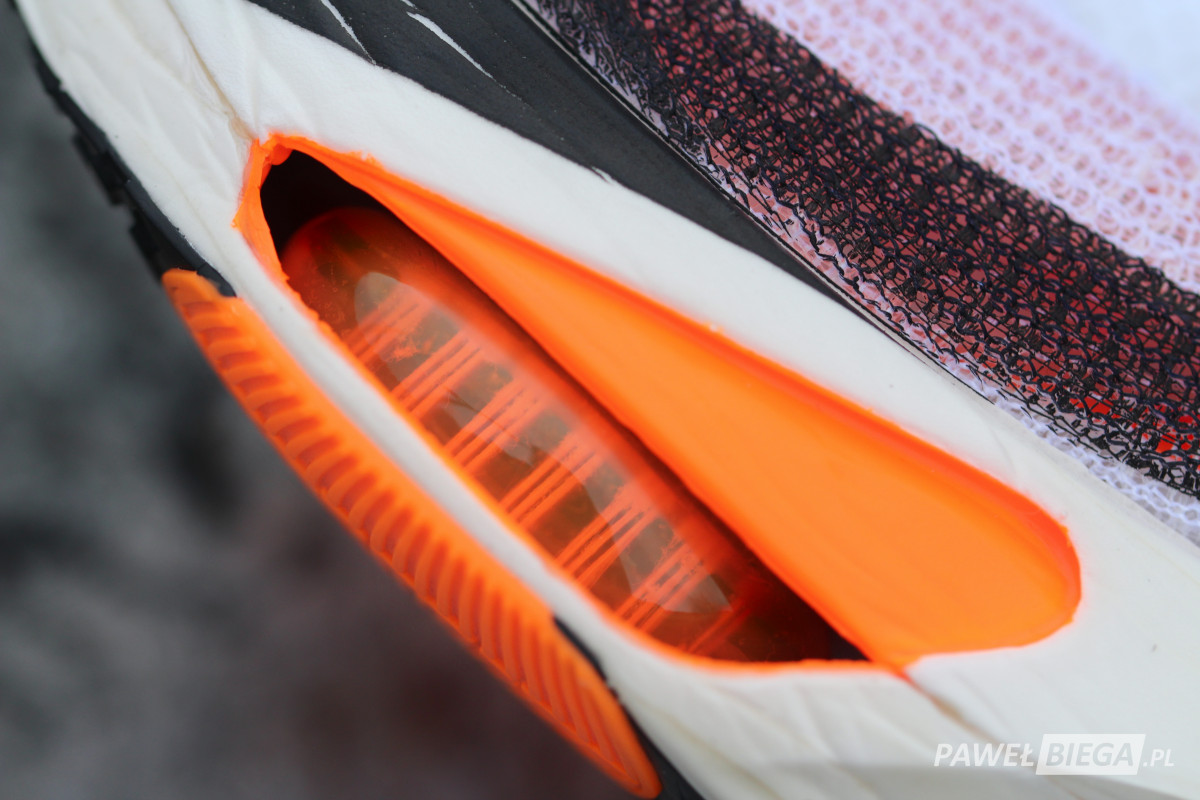
Responsiveness and dynamism can be achieved through additional stiffeners that operate on the principles of a “lever” or “trampoline.” When the foot lands, it bends and absorbs energy. When the foot pushes off, it returns to its original shape and releases energy while requiring us to expend slightly less energy to move the foot. The most common solutions currently are various carbon fiber plates and components, but other materials have also been and continue to be used on a similar principle, such as fiberglass, nylon, polypropylene, and polyurethane.
These components and the surrounding foam are designed for dynamic running with significant forefoot engagement. This explains why “fast” shoes tend to be narrow under the heel yet wider and more stable in the forefoot. This reflects the fact that the faster the pace, the greater the forefoot engagement. Furthermore, these constructions are often convenient and practical for fast running but not necessarily comfortable for slow running. That is why we call these shoes dynamic.
Rocker Geometry
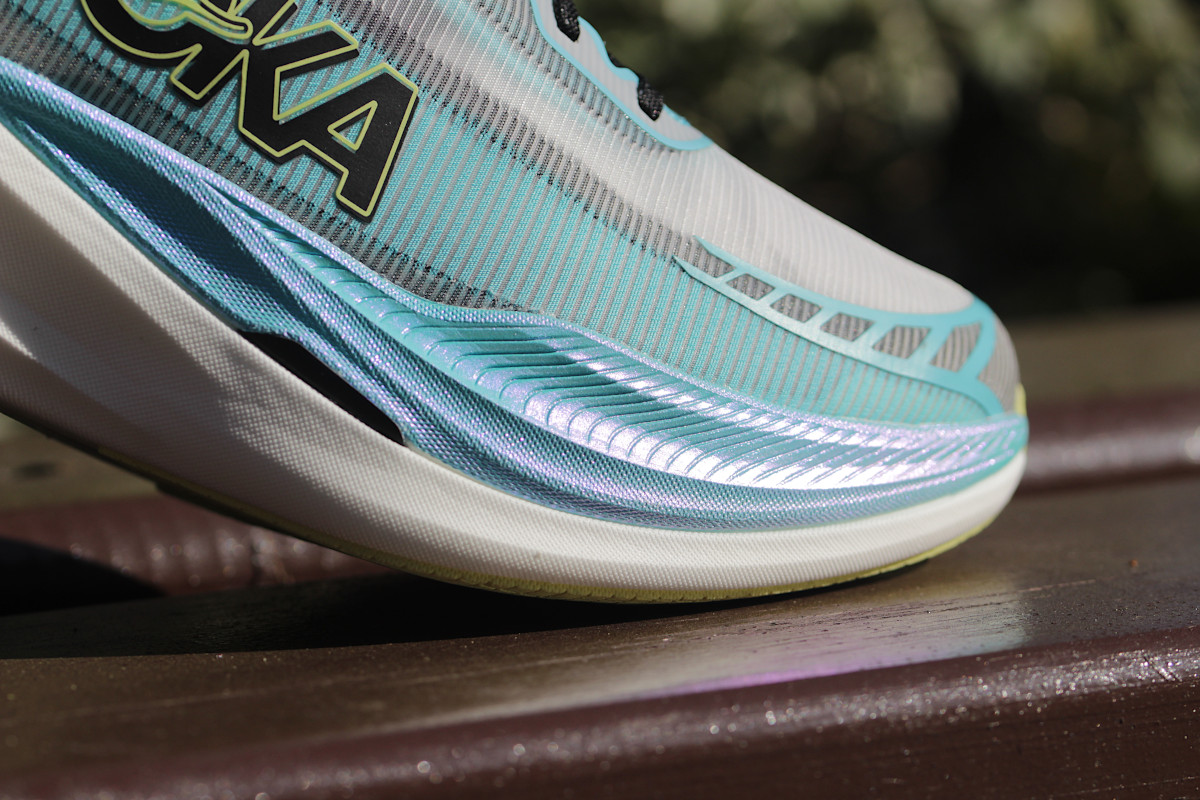
Another feature found in “fast” shoes is the “rocker.” This refers to the shoe’s contoured shape. It may, but does not have to, be combined with carbon fiber, fiberglass, or similar materials. When viewed from the side, such a shoe may have an unnaturally raised toe and sometimes a raised heel. This creates a boat-like shape that helps the shoe roll. This design is found in both training shoes, or “slow” shoes, and “fast” shoes.
In “slow” shoes, the curvature corresponds to the foot’s roll from heel to toe, which typically occurs during a slow run. This roll is often gentler than in “fast” shoes.
“Fast” shoes often have a more pronounced toe box to maximize the roll-through to the toes and the push-off from the forefoot. They are contoured so that the roll-through and push-off are as smooth, fast, and dynamic as possible.

When Do Runners Actually Benefit From Dynamic Shoes?
You’ll get the most out of dynamic running shoes if your training involves higher speeds. There’s no strict definition of “higher speeds,” but if you run at a pace faster than 5:00/km during training, you’ll likely notice a difference with dynamic shoes. At a pace of 4:00/km, you’ll notice an even greater difference.
These shoes are ideal for intervals, tempo runs, and races. Their springy midsole and stiffer construction help you maintain your running rhythm and efficiently return energy when your foot strikes the ground. During slow, relaxed runs, however, the difference is usually much smaller, which is why many runners only use dynamic shoes during faster sessions.
Are Fast Running Shoes Good for Everyday Training?
Fast running shoes are designed primarily for speed and efficiency. Comfort and stability are often secondary considerations. Therefore, these benefits are much less noticeable during slow, daily runs. Features that help with fast running can work against you.
For example, a springy and soft midsole, narrow construction, or aggressive geometry can reduce the feeling of stability, especially in the rear of the shoe. At a slow pace, these issues become much more noticeable than during dynamic running. For this reason, fast models aren’t always ideal for daily training. It’s also worth remembering that these shoes have limited durability, which is why they’re used in rotation, mainly for fast sessions and race starts.
In practice, many runners only use such models for specific training sessions. For everyday use, more stable and comfortable shoes are better, as they can handle high mileage and easy runs. You can then treat a fast model as a second shoe in your rotation. You pull them out when your plan includes tempo runs, intervals, or a race.